
Make It Make Sense
Can I Use Azelaic Acid With Tretinoin?
Answered by Jean, Nurse Practitioner Strategist | Live Pretty Wellness
The Clear Answer
Yes. Azelaic acid and tretinoin can sometimes be used as part of the same acne skincare strategy.
But "Can I use them together?" and "How should I use them?" are two different questions.
How they fit into a routine depends on your skin's tolerance, the formulations and strengths you use, what else is already in your routine, your treatment goals, and any instructions from the clinician who prescribed your tretinoin.[1]
The goal is not to fit every useful ingredient into one routine.
The goal is to give each treatment a clear job without making the routine harder for your skin to tolerate.
Why Would Someone Use Azelaic Acid With Tretinoin?
Tretinoin
Topical retinoids such as tretinoin are strongly recommended in acne treatment guidelines. They help address clogged pores and acne formation and can reduce inflammation.[1]
Azelaic acid
Azelaic acid is also used for acne. The American Academy of Dermatology notes that azelaic acid can help unclog pores, reduce acne-related bacteria and inflammation, and improve dark spots that remain after acne clears.[3]
That means the two ingredients may have overlapping benefits — but they are not identical treatments.
For someone who has both active acne and post-acne dark marks, the question may not simply be:
"Which ingredient is better?"
It may be:
"What job should each treatment have in my overall plan?"
Before You Combine Them, Answer These 5 Questions
The combination matters less than the strategy around it.
1 What Are You Trying to Treat?
Ask:
- active breakouts?
- clogged pores?
- recurring acne?
- post-acne dark spots?
- uneven tone?
- several of these at once?
The reason for adding azelaic acid matters. If tretinoin is already part of the acne plan, azelaic acid should not be added simply because it is another popular acne ingredient. Ask what additional problem you expect it to address.
Give every active a job.
2 How Well Are You Tolerating Tretinoin?
Ask:
- Is your skin comfortable?
- Are you already peeling?
- Burning?
- Stinging?
- Persistently red?
- Tender?
- Struggling with moisturizer or sunscreen?
If tretinoin already feels difficult to tolerate, adding another active may make the routine harder to interpret and harder to maintain. Azelaic acid itself can cause local irritation, burning, stinging, or itching in some people.[3]
A routine that works on paper still has to work on your skin.
If tretinoin has been hard to read from the beginning, How Do I Know If Tretinoin Is Purging My Skin or Breaking Me Out? walks through interpreting that separately.
3 What Else Is Already in the Routine?
Take an inventory:
- benzoyl peroxide
- salicylic acid
- glycolic or lactic acids
- exfoliating toners
- vitamin C
- spot treatments
- scrubs
- acne cleansers
- prescription medications
- pigmentation products
The question is not simply whether azelaic acid and tretinoin can coexist. The better question is whether the entire routine remains coherent and tolerable.
Your skin experiences the total routine — not two ingredients in isolation.
4 Do You Need to Use Them at the Same Time?
Being compatible with the same overall skincare plan does not necessarily mean two treatments must be layered during the same application.
Depending on the individual plan, products may sometimes be separated by time of day or incorporated differently to improve simplicity or tolerability.
Same routine does not have to mean same moment.
5 What Does Your Prescriber Expect?
Tretinoin is a prescription medication in the United States.
If it was prescribed for you, the instructions for your specific medication and treatment plan matter. Adding skincare around a prescription should not require ignoring the prescription instructions.
If you are experiencing significant irritation or are unsure how another active fits into your prescribed regimen, ask the prescribing healthcare professional.
Can I Use Azelaic Acid in the Morning and Tretinoin at Night?
For some people, separating azelaic acid and tretinoin by time of day can be one way to organize a routine. But it is not a universal requirement.
Whether that arrangement makes sense depends on:
- your specific products
- your tretinoin instructions
- skin tolerance
- other actives
- sunscreen use
- acne severity
- pigmentation goals
Morning/night is an organizational strategy — not a rule that makes the combination automatically safe or effective.
Can I Apply Azelaic Acid and Tretinoin in the Same Routine?
Sometimes they may be used within the same overall treatment regimen, but whether you should layer them in the same application depends on your individual routine and tolerance.
Direct clinical evidence specifically studying tretinoin plus azelaic acid together is more limited than the evidence supporting each treatment individually. One published case series describes using them together in a small number of patients, which is a description of clinical use rather than proof that the combination is superior or appropriate for everyone.[5]
If layering them causes significant burning, stinging, redness, tenderness, or peeling, that is useful information about tolerability — not proof that the routine needs to become more aggressive.
Which Goes First: Azelaic Acid or Tretinoin?
There is not one universal order that is correct for every formulation and every treatment plan.
Product vehicle matters. Prescription instructions matter. The rest of the routine matters. Tolerance matters.
Instead of memorizing an internet layering rule, understand:
- what each treatment is doing
- when each treatment is intended to be used
- whether the combination is tolerable
- whether unnecessary layers are making the routine more complicated
Order matters less than having a routine that makes clinical and practical sense.
Can Azelaic Acid Help the Dark Spots My Acne Leaves Behind?
Yes. Azelaic acid can help with the dark spots that remain after acne clears.[3]
Those flat brown or darker marks are often post-inflammatory hyperpigmentation rather than true acne scars. This distinction is especially important for people who feel that their acne is "still there" because the marks remain long after the active lesion has healed.
Controlling new acne and addressing the marks acne leaves behind are related — but they are not exactly the same goal.
Will Using Both Work Faster?
Not necessarily.
Adding another evidence-based ingredient does not automatically:
- double effectiveness
- cut treatment time in half
- prevent every breakout
- clear dark spots twice as fast
More treatment can also mean more complexity and potentially more irritation.
More actives does not equal faster skin.
What If My Skin Starts Burning, Stinging, or Peeling?
Do not automatically interpret irritation as proof that the products are "working." Topical treatments can cause irritation.[4]
Look at:
- severity
- persistence
- timing
- what changed
- how many actives are being used
- whether your prescribed treatment remains tolerable
If symptoms are significant, persistent, worsening, or concerning, contact the healthcare professional managing your treatment.
Your tolerance is data.
If breakouts have continued throughout treatment rather than starting with a new product, Why Am I Still Breaking Out on Tretinoin? covers that question.
Where Azelaic Acid + Tretinoin Fit Into Jean's Bigger Picture
Jean does not evaluate acne treatments as isolated ingredients.
Jean's Healthy Skin Triad considers Healthy Skin Balance, Healthy Skin Barrier, and Healthy Pore Care, with Clear Skin at their intersection.
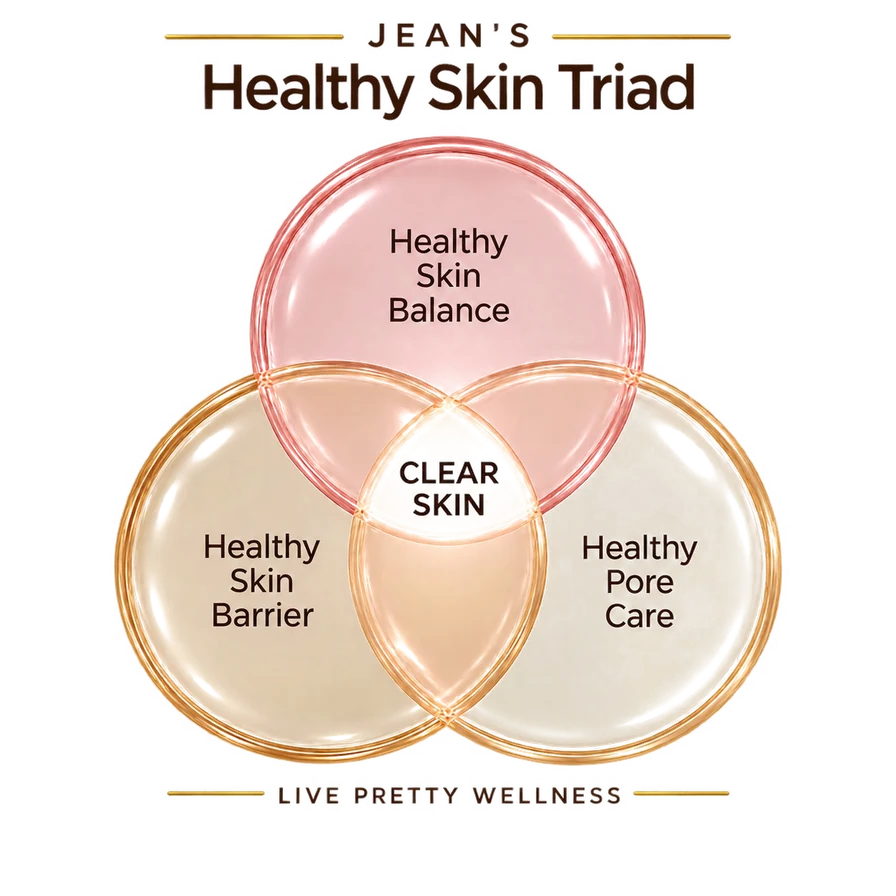
Tretinoin and azelaic acid may both have useful roles, but the routine still has to support acne control, treatment tolerance, pigmentation goals, and the rest of the skin strategy.
Jean’s “Should I Add It?” Check
Before adding azelaic acid to a tretinoin routine, ask:
- JobWhat exactly am I asking azelaic acid to do?
- ToleranceIs my skin already tolerating tretinoin comfortably?
- LoadHow many other active treatments am I already using?
- TimingDoes this need to be used at the same time as tretinoin?
- InstructionsDoes the plan fit the instructions for my prescription?
- ResponseAfter adding it, is the overall routine still tolerable and understandable?
Don't add an ingredient until you know its job.
When This Combination Deserves a Closer Look
Consider individualized guidance when:
- tretinoin is already difficult to tolerate
- significant burning, stinging, redness, tenderness, or peeling develops
- acne is worsening or becoming more severe
- deep or painful lesions are developing
- scarring is occurring or becoming more likely
- several actives or prescriptions are being combined
- you cannot tell which product is causing a reaction
- you are considering changing how a prescription is used
- the diagnosis or treatment plan is uncertain
- pregnancy or pregnancy planning is relevant
If you are pregnant, planning pregnancy, or have medication-safety questions, discuss your tretinoin and skincare regimen promptly with your healthcare professional.
Live Pretty Wellness provides education and individualized skincare strategy. It does not replace urgent or specialist medical care.
Jean's Bottom Line
Yes, azelaic acid and tretinoin can sometimes belong in the same strategy.
But don't stop at:
"Can I combine them?"
Ask:
- What job does each treatment have?
- Can my skin tolerate the total routine?
- Do they need to be used at the same time?
- What else am I already using?
- What am I trying to improve — active acne, dark spots, or both?
A smart routine is not the one with the most good ingredients. It is the one where every treatment has a reason to be there.
Want Jean's Help Making Sense of Your Skin?
When prescriptions, acne treatments, dark-spot products, and skincare all overlap, knowing what belongs in the routine can be harder than finding another product.
Get a Personalized Skincare StrategyWant to Meet Jean First?
Meet Jean Live — Free Q&ASources
- Reynolds RV, Yeung H, et al. Guidelines of care for the management of acne vulgaris. Journal of the American Academy of Dermatology. 2024;90(5):1006.e1–1006.e30. View on PubMed (opens in a new tab)
- American Academy of Dermatology. American Academy of Dermatology issues updated guidelines for the management of acne. View announcement (aad.org, opens in a new tab)
- American Academy of Dermatology. Acne: Diagnosis and Treatment. View resource (aad.org, opens in a new tab)
- National Institute for Health and Care Excellence (NICE). Acne vulgaris: management. NICE Guideline NG198. Last updated April 30, 2026. View guideline (nice.org.uk, opens in a new tab)
- St Surin-Lord S, Miller J. Topical Treatment of Truncal Acne with Tretinoin Lotion 0.05% and Azelaic Acid Foam. Case Reports in Dermatological Medicine. 2020. View on PubMed (opens in a new tab) This is a small four-patient case series describing clinical use, not high-level evidence that the combination is superior or appropriate for everyone.
Jean's own perspectives and frameworks above are her clinical reasoning, not claims attributed to these sources.

Jean
Nurse Practitioner Strategist
Founder, Live Pretty Wellness
Jean combines clinical reasoning with practical skincare strategy to help people make sense of acne-prone skin, prescriptions, skincare, skin response, and goals as parts of one picture.
About JeanYou May Be Wondering Next…
- Why Am I Still Breaking Out on Tretinoin?
- How Do I Know If Tretinoin Is Purging My Skin or Breaking Me Out?
- Why Does My Acne Keep Coming Back?
- Can I Use Salicylic Acid With Tretinoin?
- Can I use benzoyl peroxide with tretinoin?
- Can I use vitamin C with tretinoin?
- Why is my skin irritated while using tretinoin?
- What should I use for dark spots while using tretinoin?
More answers are coming.
Back to Make It Make Sense