
Make It Make Sense
Can I Use Salicylic Acid With Tretinoin?
Answered by Jean, Nurse Practitioner Strategist | Live Pretty Wellness
The Clear Answer
Sometimes — but this combination deserves more caution than simply asking whether the ingredients are "compatible."
Tretinoin and salicylic acid can both be used for acne and clogged pores, but using them together can increase irritation for some people.
The current FDA labeling for Retin-A Micro specifically warns that over-the-counter acne products containing salicylic acid may increase dryness, redness, and peeling when used with tretinoin.[5]
The question is not only: "Can I use both?"
It is: "Do I need both — and can my skin tolerate the total routine?"
If tretinoin is already doing the job you wanted salicylic acid to do, adding another exfoliating acne treatment may create more complexity without automatically creating a better plan.
What Does Salicylic Acid Do That Tretinoin Already Does?
Salicylic acid
The American Academy of Dermatology describes salicylic acid as an acne treatment that helps unclog pores and exfoliate the skin.[3]
It is commonly found in:
- cleansers
- leave-on toners
- serums
- spot treatments
- moisturizers
Tretinoin
Tretinoin is a topical retinoid. Topical retinoids are strongly recommended in acne guidelines and help address clogged pores and inflammation.[1]
That means both treatments may be relevant to acne and clogged pores — but they are not identical.
The more useful question is:
"What additional job is salicylic acid doing in this routine?"
Before You Add Salicylic Acid, Answer These 5 Questions
Don't build the routine around ingredient popularity. Build it around the skin's needs.
1 What Problem Are You Trying to Solve?
Ask:
- clogged pores?
- blackheads?
- whiteheads?
- oily-feeling skin?
- recurrent breakouts?
- rough texture?
- something else?
The reason matters. Salicylic acid should not be added simply because it is a familiar acne ingredient. If tretinoin is already part of the plan, identify the specific gap salicylic acid is expected to fill.
Every active needs a job.
2 How Well Are You Tolerating Tretinoin?
Ask:
- burning?
- stinging?
- persistent redness?
- peeling?
- tightness?
- tenderness?
- worsening sensitivity?
- difficulty using moisturizer or sunscreen comfortably?
If tretinoin already feels difficult to tolerate, adding salicylic acid may increase irritation and make the routine harder to interpret. The FDA labeling for Retin-A Micro specifically warns that concomitant OTC acne products containing salicylic acid can increase dryness, redness, and peeling.[5]
Tolerance is part of treatment strategy.
If it has been hard to tell irritation apart from breakouts, How Do I Know If Tretinoin Is Purging My Skin or Breaking Me Out? works through that separately.
3 What Form of Salicylic Acid Are You Using?
Not every salicylic-acid product creates the same exposure.
Consider whether it is:
- a rinse-off cleanser
- a leave-on toner
- a serum
- a spot treatment
- a moisturizer containing salicylic acid
The strength, vehicle, contact time, frequency, and rest of the routine can influence tolerability.
The ingredient name is only part of the story. The formulation matters too.
4 What Else Is Already in Your Routine?
Take an inventory:
- benzoyl peroxide
- azelaic acid
- glycolic acid
- lactic acid
- exfoliating toners
- vitamin C
- prescription acne medications
- acne cleansers
- spot treatments
- scrubs
- professional exfoliating treatments
Tretinoin plus salicylic acid may not be the only combination your skin is experiencing. The total active load matters.
Your skin does not read ingredient lists one product at a time. It experiences the whole routine.
If azelaic acid is one of the actives already in the plan, Can I Use Azelaic Acid With Tretinoin? covers that pairing on its own.
5 Do You Need Them at the Same Time?
Even when two treatments belong in the same overall skincare strategy, they do not necessarily need to be applied during the same routine.
Some plans may separate treatments by time of day or by different days to improve tolerability. But there is no one universal schedule that is correct for everyone.
Same strategy does not have to mean same application.
Can I Use Salicylic Acid in the Morning and Tretinoin at Night?
For some people, separating them by time of day may be one way to reduce overlap and organize the routine. But morning/night separation does not automatically eliminate irritation risk.
The decision still depends on:
- product strength and formulation
- how your skin tolerates tretinoin
- frequency of use
- other actives
- acne severity
- prescription instructions
- sunscreen use
Spacing products apart can organize a routine. It does not guarantee the routine is tolerable.
Can I Use a Salicylic Acid Cleanser With Tretinoin?
Sometimes, but a rinse-off cleanser is still an active acne product and can still contribute to irritation.
People often assume a salicylic-acid cleanser "doesn't count" because it gets rinsed off. But the better question is whether the cleanser is helping the routine without making the skin feel tighter, drier, more irritated, or harder to manage.
Consider:
- how often it is used
- how long it stays on the skin
- how strong the product is
- whether tretinoin already causes irritation
- what cleanser is used on non-salicylic-acid days
- what other actives are present
Should I Alternate Salicylic Acid and Tretinoin?
Alternating can be one way some routines are organized, but there is no universal schedule that fits every skin type, product, or prescription plan.
The useful questions are:
- Why are you using salicylic acid?
- How often does your skin tolerate tretinoin?
- What else is in the routine?
- Is irritation already present?
- Does the schedule match your prescriber's expectations?
Does Salicylic Acid Make Tretinoin Work Better?
Not automatically.
Using both does not automatically mean:
- faster acne clearance
- better pore clearing
- fewer breakouts
- less purging
- faster results
Adding salicylic acid may be useful in some routines, but it may also add irritation or redundancy.
More acne treatment is not automatically better acne treatment.
If breakouts have continued throughout treatment, Why Am I Still Breaking Out on Tretinoin? looks at that question directly.
Can I Exfoliate While Using Tretinoin?
Possibly — but tretinoin already changes how skin cells behave, so exfoliation should not be added automatically.
People often use the word "exfoliation" to describe several different things:
- salicylic acid
- glycolic or lactic acid
- scrubs
- exfoliating pads
- peels
- professional exfoliating treatments
The relevant question is not:
"Am I allowed to exfoliate?"
It is:
"What problem am I trying to solve, and how much irritation is the total routine creating?"
What If My Skin Starts Burning, Peeling, or Getting Very Dry?
Do not interpret irritation as proof that the combination is working.
The current FDA labeling for Retin-A Micro warns that combining tretinoin with OTC acne products containing salicylic acid can increase dryness, redness, and peeling.[5]
Look at:
- severity
- persistence
- timing
- what changed
- how often each active is being used
- how many other acne treatments are present
- whether the prescribed tretinoin remains tolerable
If irritation is significant, persistent, worsening, or concerning, contact the healthcare professional managing your treatment.[4]
Irritation is information — not a badge of progress.
Where Salicylic Acid + Tretinoin Fit Into Jean's Bigger Picture
Jean does not evaluate acne treatments as isolated ingredients.
Jean's Healthy Skin Triad considers Healthy Skin Balance, Healthy Skin Barrier, and Healthy Pore Care, with Clear Skin at their intersection.
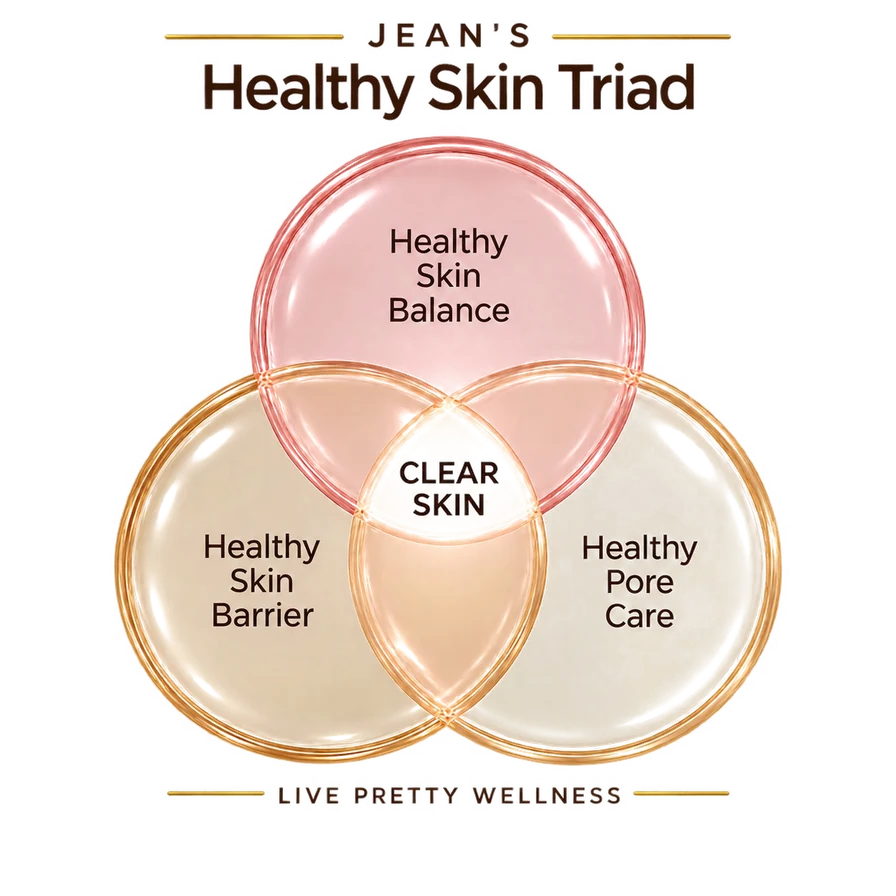
Salicylic acid and tretinoin may both support pore care, but the overall plan still has to preserve treatment tolerability and skin balance.
The goal is not maximum exfoliation. The goal is a routine that controls acne without creating unnecessary instability.
Jean’s “Do I Need Both?” Check
Before adding salicylic acid to tretinoin, ask:
- JobWhat problem am I asking salicylic acid to solve?
- OverlapIs tretinoin already addressing part of that problem?
- ToleranceIs my skin already comfortable with tretinoin?
- FormIs the salicylic acid in a cleanser, leave-on product, or something else?
- LoadWhat other actives are already in the routine?
- ResponseAfter adding it, is the routine still comfortable, understandable, and useful?
Don't add exfoliation just because exfoliation exists.
When This Combination Deserves a Closer Look
Consider individualized guidance when:
- tretinoin is already difficult to tolerate
- significant redness, burning, stinging, dryness, or peeling develops
- acne is worsening
- painful or deep lesions develop
- scarring is occurring or becoming more likely
- several actives or prescriptions are being combined
- you cannot tell what is causing irritation
- the routine has become difficult to interpret
- you are considering changing how a prescription is used
- the diagnosis or treatment plan is uncertain
- pregnancy or pregnancy planning is relevant
If you are pregnant, planning pregnancy, or have medication-safety questions, discuss tretinoin and your skincare regimen promptly with your healthcare professional.
Live Pretty Wellness provides education and individualized skincare strategy. It does not replace urgent or specialist medical care.
Jean's Bottom Line
Salicylic acid and tretinoin can sometimes belong in the same acne strategy — but that does not mean every tretinoin routine needs salicylic acid.
Ask:
- What job is salicylic acid doing?
- Is tretinoin already doing part of that job?
- How well is my skin tolerating the current plan?
- What form of salicylic acid am I using?
- What else is already in the routine?
The goal is not to collect every acne ingredient. The goal is to build a routine where every treatment earns its place.
Want Jean's Help Making Sense of Your Skin?
When prescriptions, acids, cleansers, acne treatments, and skin goals overlap, knowing what actually belongs in the routine can be harder than finding another product.
Get a Personalized Skincare StrategyWant to Meet Jean First?
Meet Jean Live — Free Q&ASources
- Reynolds RV, Yeung H, et al. Guidelines of care for the management of acne vulgaris. Journal of the American Academy of Dermatology. 2024;90(5):1006.e1–1006.e30. View on PubMed (opens in a new tab)
- American Academy of Dermatology. Acne clinical guideline. View guideline (aad.org, opens in a new tab)
- American Academy of Dermatology. Acne: Diagnosis and treatment. View resource (aad.org, opens in a new tab)
- National Institute for Health and Care Excellence (NICE). Acne vulgaris: management. NICE Guideline NG198. Last updated April 30, 2026. View guideline (nice.org.uk, opens in a new tab)
- U.S. Food and Drug Administration. RETIN-A MICRO (tretinoin) prescribing information. Current 2026 labeling. View FDA label (PDF, opens in a new tab) The labeling warns that concomitant topical OTC acne products containing salicylic acid may increase local irritation, including dryness, erythema, and peeling. It does not state that the two can never be used together.
Jean's own perspectives and frameworks above are her clinical reasoning, not claims attributed to these sources.

Jean
Nurse Practitioner Strategist
Founder, Live Pretty Wellness
Jean combines clinical reasoning with practical skincare strategy to help people make sense of acne-prone skin, prescriptions, skincare, skin response, and goals as parts of one picture.
About JeanYou May Be Wondering Next…
- Can I Use Azelaic Acid With Tretinoin?
- Why Am I Still Breaking Out on Tretinoin?
- How Do I Know If Tretinoin Is Purging My Skin or Breaking Me Out?
- Why Does My Acne Keep Coming Back?
- Why Does Every Moisturizer Seem to Break Me Out?
- Can I use benzoyl peroxide with tretinoin?
- Can I use vitamin C with tretinoin?
- Why is my skin irritated while using tretinoin?
- Do I need an exfoliant if I use tretinoin?
- What should I use for dark spots while using tretinoin?
More answers are coming.
Back to Make It Make Sense