
Make It Make Sense
How Do I Fade Dark Spots Without Breaking Out Again?
Answered by Jean, Nurse Practitioner Strategist | Live Pretty Wellness
The Clear Answer
If acne caused the dark spots, fading the marks is only half the job. You also have to reduce the new inflammation that keeps creating more of them.
Flat brown, black, or darker marks left after acne may be post-inflammatory hyperpigmentation, or PIH. These marks are not necessarily permanent acne scars, and they can fade over time.[1]
But the strategy matters.
If you aggressively layer brightening acids, exfoliants, retinoids, and acne treatments trying to erase the marks faster, irritation can become another problem — and inflammation itself can contribute to discoloration.[4]
Don’t just treat the mark. Stop creating the next one.
A smarter approach considers four things together:
- active acne
- pigment
- irritation and tolerance
- photoprotection
The goal is not simply to fade yesterday’s breakout. It is to reduce the cycle that keeps leaving new marks behind.
First: Is It a Dark Spot or an Acne Scar?
They are not the same thing.
After acne clears, some people develop a flat area of discoloration where the blemish used to be. This is commonly called post-inflammatory hyperpigmentation, or PIH.[1]
Depending on skin tone and the inflammatory response, post-acne discoloration may appear brown, dark brown, gray-brown, purple, or otherwise darker than the surrounding skin.
A true acne scar involves a change in the skin’s texture. Examples include:
- depressed or indented scars
- raised scars
A flat color change is not automatically an acne scar.
Telling them apart is not something to settle by squinting in the mirror. It is part of an evaluation.[2]
Why Do Pimples Leave Dark Spots?
Inflammation can stimulate excess pigment production in the skin.
After an inflammatory skin injury such as acne, the skin can produce excess melanin in the affected area. This is post-inflammatory hyperpigmentation.[4]
PIH can occur in any skin tone, but it is especially common and often more persistent in people with darker skin tones.[7]
That means the acne itself may resolve before the evidence of the breakout disappears.
The pimple can be gone while the inflammation’s footprint remains.
Why Do My Dark Spots Keep Coming Back?
Often because new acne keeps creating new inflammation.
Imagine fading three old marks while developing three new inflammatory breakouts. The pigmentation routine may be working. But the overall appearance may not improve much, because new marks keep replacing old ones.
This is why acne-associated hyperpigmentation often requires two goals at the same time:[5]
- reduce active acne and future inflammation
- address existing discoloration
Preventing the next mark is part of treating the marks you already have.
Can Trying Too Hard to Fade Dark Spots Make Things Worse?
Yes. Irritation can work against the goal.
Products used for acne and pigmentation can cause:
- dryness
- burning
- stinging
- peeling
- redness
- tenderness
- general irritation
This is especially true when several irritating products are layered, or used more aggressively than the skin tolerates.[3]
In skin prone to PIH, additional inflammation or irritation can contribute to more discoloration.[5]
More active ingredients does not automatically mean faster clearing.
Before You Add Another Dark-Spot Product, Read These 5 Clues
These are the things I want to understand before anything else gets added.
1. Are You Still Breaking Out?
Are new inflammatory pimples still appearing regularly?
If yes, preventing new acne remains part of the pigmentation strategy. Fading old marks while ignoring active acne can become an endless cycle.
2. What Are You Actually Treating?
Is the concern:
- flat discoloration?
- uneven tone?
- indented texture?
- raised texture?
- active acne plus discoloration?
Different concerns require different strategies. A serum marketed for “acne scars” cannot automatically address every post-acne change.
3. What Is Already in Your Routine?
Take an honest inventory:
- retinoid or tretinoin
- azelaic acid
- benzoyl peroxide
- salicylic acid
- exfoliating acids
- vitamin C
- other brightening products
- prescription treatments
- moisturizer
- sunscreen
Before adding another active, understand what the routine is already doing.
4. How Is Your Skin Tolerating It?
Are you experiencing:
- persistent burning
- stinging
- excessive peeling
- significant dryness
- tenderness
- redness
- ongoing discomfort
A pigmentation strategy that your skin cannot tolerate is not automatically a better strategy.
5. Are You Protecting the Progress?
What role does sunscreen play in the routine?
Photoprotection is an important part of managing hyperpigmentation. AAD guidance emphasizes sunscreen when treating dark spots, and specifically discusses tinted sunscreen containing iron oxide as helpful protection against visible light for people prone to hyperpigmentation.[1]
Sunscreen protects the progress. It is not a treatment for active acne.
What Ingredients Can Help With Acne Dark Spots?
Several ingredients used in acne-prone skin can also play a role in improving post-acne hyperpigmentation.[5]
What follows is general education, not an individualized regimen. Strength, frequency, and combination belong in a plan built for your skin.
Azelaic Acid
Azelaic acid is used in acne treatment and can also help address hyperpigmentation.[7]
This dual role can make it particularly relevant when someone is dealing with active acne plus post-acne marks.
Topical Retinoids
Topical retinoids are established acne treatments and may also help improve post-inflammatory hyperpigmentation over time.[6]
Examples used for acne include:
- adapalene
- tretinoin
- tazarotene
- trifarotene
Retinoids can also irritate the skin. More frequent or more aggressive use is not automatically better, and prescription instructions should not be changed on your own.
Vitamin C
Vitamin C is commonly used in skincare for pigmentation and antioxidant benefits.
However, the fact that vitamin C may play a role in a pigmentation routine does not mean every acne-prone person needs it, or that every vitamin C formulation will work well in every routine.
Exfoliating Acids
Some hydroxy acids may be used in approaches to hyperpigmentation and/or acne.[5]
But adding more exfoliation to a routine already containing retinoids, acne medications, or other irritating actives can increase tolerability problems.
What About Hydroquinone?
Hydroquinone is a depigmenting medication used for hyperpigmentation, but it should not be treated like a casual “more is better” skincare ingredient.[4]
Appropriate use depends on factors such as:
- what is causing the pigmentation
- the formulation and concentration
- duration of use
- other products or medications being used
- the individual skin situation
That is a conversation to have with a clinician rather than a product to add indefinitely on your own.
Do I Need to Exfoliate More to Fade the Marks Faster?
Not necessarily.
This is a common trap. Someone sees persistent pigmentation and thinks:
“I need stronger exfoliation.”
Then:
- another acid gets added
- the retinoid continues
- the acne treatment continues
- another brightening serum gets added
The routine becomes harder to tolerate.
Your skin does not give bonus points for the number of actives in your routine.
Why Does Sunscreen Matter for Dark Spots?
Photoprotection is an important part of managing hyperpigmentation.
Ultraviolet radiation can worsen pigmentation.
Visible light can also contribute to hyperpigmentation, particularly in darker skin tones. AAD recommends broad-spectrum SPF 30 or higher when managing dark spots, and discusses tinted sunscreen containing iron oxide for protection against visible light.[1]
Sunscreen does not instantly fade pigmentation, and it does not replace acne treatment. It protects the work you are already doing.
How Long Do Acne Dark Spots Take to Fade?
Usually longer than people want them to.
PIH can fade over time, but the timeline varies depending on:
- depth of pigment
- skin tone
- ongoing inflammation
- sun and visible-light exposure
- treatment
- irritation
- whether new acne continues
AAD notes that some dark spots may take months to fade, and deeper discoloration may persist considerably longer.[1]
Acne can improve before the evidence of acne disappears.
What If I’m Using Tretinoin and Still Have Dark Spots?
That does not automatically mean tretinoin is failing.
Tretinoin is an acne treatment, and topical retinoids may also help improve hyperpigmentation. But pigmentation can persist after acne lesions improve.[6]
Also worth considering:
- whether new acne is still developing
- how long treatment has been used
- adherence
- irritation
- photoprotection
- the rest of the routine
If the broader tretinoin question is what you are really asking, that answer lives here.
What If the Product Fading My Marks Is Irritating My Skin?
Persistent irritation deserves attention rather than being treated as proof that the product is “working.”
Burning, significant stinging, persistent peeling, tenderness, or substantial irritation may mean the routine needs to be reassessed.[3]
If a prescription is involved, that reassessment belongs with the clinician who prescribed it rather than a sudden solo decision to stop.
Where Dark Spots Fit Into Jean's Bigger Picture
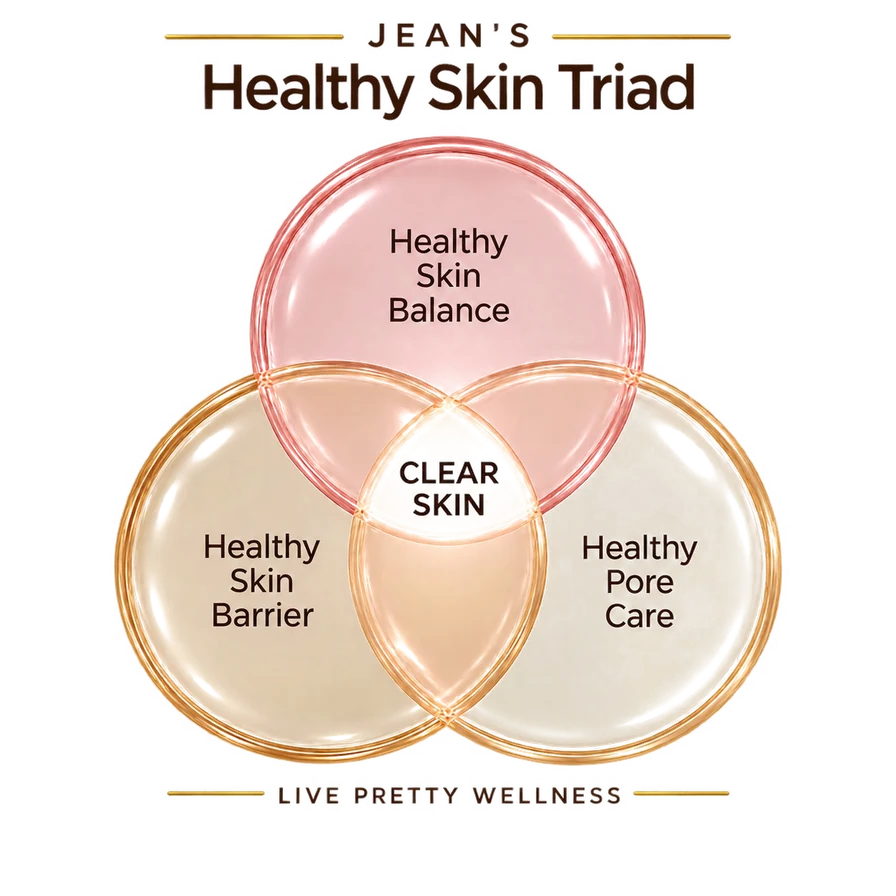
Jean's Healthy Skin Triad considers Healthy Skin Balance, Healthy Skin Barrier, and Healthy Pore Care, with Clear Skin at their intersection.
When someone is focused on hyperpigmentation, it is easy for the entire routine to become about fading pigment. But acne-prone skin still needs a strategy that considers:
- preventing new clogged pores and inflammation
- keeping acne treatment tolerable
- avoiding unnecessary irritation
- supporting the skin
- protecting against factors that can worsen pigmentation
The goal is not simply to fade the spot. The goal is to reduce the cycle that keeps creating the spots.
Jean’s “Dark Spot Without Another Breakout” Check
Before adding another brightening product, ask:
- AcneAm I still developing new inflammatory breakouts?
- MarkAm I treating flat discoloration — or a true texture change?
- RoutineWhat acne and pigmentation actives am I already using?
- ToleranceIs my skin comfortable enough to stay consistent?
- ProtectionAm I protecting the skin from UV and visible-light exposure that may worsen pigmentation?
- StrategyWill this new product solve a missing problem — or simply add another active?
Don’t just fade the last breakout. Plan for the next one.
When Dark Spots Deserve a Closer Look
Consider professional evaluation when:
- acne remains active or is worsening
- pigmentation is persistent or worsening
- significant irritation is developing
- you cannot tell whether marks are pigmentation or scars
- deep or painful acne is continuing
- true scarring is developing
- the routine contains several prescriptions or actives and has become difficult to manage
- pigmentation appears unusual or is not clearly related to acne
- repeated product changes are making the pattern impossible to interpret
Live Pretty Wellness provides education and individualized skincare strategy. It does not replace urgent or specialist medical care.
Jean's Bottom Line
If acne created the dark spots, don’t build a strategy that only treats the evidence it left behind.
Work on the cycle:
- control the acne
- address the pigment
- respect tolerance
- protect the progress
Clearer-looking skin is not just about fading yesterday’s mark. It is also about creating fewer new ones tomorrow.
Want Jean's Help Making Sense of Your Skin?
When acne, dark spots, prescriptions, brightening products, and irritation all become separate problems, it can be hard to know what your routine should actually prioritize.
Get a Personalized Skincare StrategyWant to Meet Jean First?
Meet Jean Live — Free Q&ASources
- American Academy of Dermatology. How to fade dark spots in darker skin tones. View resource (aad.org, opens in a new tab)
- American Academy of Dermatology. Acne: Signs and symptoms. View resource (aad.org, opens in a new tab)
- American Academy of Dermatology. Acne: Diagnosis and treatment. View resource (aad.org, opens in a new tab)
- Mar K, Khalid B, Maazi M, et al. Treatment of Post-Inflammatory Hyperpigmentation in Skin of Colour: A Systematic Review. Journal of Cutaneous Medicine and Surgery. 2024;28(5):473–480. View on PubMed (opens in a new tab)
- Taylor SC, et al. Treatment recommendations for acne-associated hyperpigmentation: Results of the Delphi consensus process and a literature review. Journal of the American Academy of Dermatology. 2023. View on PubMed (opens in a new tab)
- Callender VD, Baldwin H, Cook-Bolden FE, Alexis AF, Stein Gold L, Guenin E. Effects of Topical Retinoids on Acne and Post-inflammatory Hyperpigmentation in Patients with Skin of Color: A Clinical Review and Implications for Practice. American Journal of Clinical Dermatology. 2022;23(1):69–81. View on PubMed (opens in a new tab)
- Chiang C, Ward M, Gooderham M. Dermatology: how to manage acne in skin of colour. Drugs in Context. 2022. View on PubMed (opens in a new tab)
Jean's own perspectives and frameworks above are her clinical reasoning, not claims attributed to these sources.

Jean
Nurse Practitioner Strategist
Founder, Live Pretty Wellness
Jean combines clinical reasoning with practical skincare strategy to help people make sense of acne-prone skin, prescriptions, skincare, skin response, and goals as parts of one picture.
About JeanYou May Be Wondering Next…
- Why Does My Acne Keep Coming Back?
- Why Does Every Moisturizer Seem to Break Me Out?
- Why Do I Keep Breaking Out in the Same Spot?
- Can I Use Azelaic Acid With Tretinoin?
Looking for more of Jean's educational gems?
Explore Jean's PicksBack to Make It Make Sense