
Make It Make Sense
How Do I Know If Tretinoin Is Purging My Skin or Breaking Me Out?
Answered by Jean, Nurse Practitioner Strategist | Live Pretty Wellness
The Clear Answer
There is no single sign that can prove a breakout is "tretinoin purging."
When your skin changes after starting tretinoin, look at the whole pattern: when it started, where the breakouts are appearing, whether they resemble your usual acne, whether burning, stinging, peeling, or significant irritation is happening, what else changed in your routine, and whether the pattern is improving or continuing to worsen.[1]
The useful question is not only:
"Is this purging?"
It is:
"What else could explain what my skin is doing?"
That distinction matters because acne, tretinoin-related irritation, changes elsewhere in the routine, and other skin conditions can sometimes be interpreted as the same thing when you are looking only at new bumps.
Before You Call It a Purge, Read These 5 Clues
No single clue makes the diagnosis. Look at the pattern together.
1 When Did the Change Start?
Timing matters because topical retinoids affect follicular cell turnover and can also cause irritation, particularly during treatment initiation.[4]
But timing alone cannot prove that new lesions are a purge.
Ask:
- When did you start tretinoin?
- Did the change begin after starting it?
- Did you recently change strength or how you use it?
- Did you restart after a break?
- Did anything else change at the same time?
"After tretinoin" does not automatically mean "because of tretinoin."
2 Where Are the Breakouts Appearing?
Compare the new pattern with your usual acne.
Ask:
- Are lesions appearing in areas where you commonly break out?
- Are they appearing somewhere that is unusual for you?
- Has the distribution changed?
- Are areas exposed to hair products, makeup, masks, or other skincare behaving differently?
Location can be useful context, but it still cannot diagnose purging by itself.
3 Is This Only Acne — or Is Your Skin Irritated Too?
Notice whether you are experiencing:
- burning
- stinging
- persistent redness
- tenderness
- significant peeling
- tightness
- rawness
- worsening sensitivity
Topical retinoids can cause irritation.[4] Irritation can occur alongside acne, which is one reason the picture becomes confusing.
A person may be asking:
"Am I purging?"
when another important question is:
"How well is my skin tolerating this treatment?"
Breakouts and irritation are not mutually exclusive.
4 Did Tretinoin Change — or Did the Routine Change?
Your skin does not experience tretinoin in isolation.
Consider whether you also changed:
- cleanser
- moisturizer
- sunscreen
- benzoyl peroxide
- salicylic acid
- azelaic acid
- exfoliating acids
- vitamin C
- spot treatments
- makeup
- hair products
- professional treatments
- how frequently you use other actives
If three things changed at once, the skin cannot tell you which product you were testing.
The more variables you change, the harder the breakout becomes to interpret.
5 What Direction Is the Pattern Going?
Do not judge the skin from one photograph or one bad morning.
Look at the trajectory.
Ask:
- Are new lesions becoming less frequent?
- Is the overall pattern settling?
- Is irritation becoming easier or harder to tolerate?
- Are breakouts becoming deeper or more painful?
- Is acne spreading or becoming more severe?
- Is scarring becoming a concern?
- Is the pattern simply continuing without meaningful improvement?
The direction of the pattern can be more informative than obsessing over one individual lesion.
Purging, Irritation, or Breakout? What Each Question Is Really Asking
These are three different questions, not three verdicts. They often overlap, and none of them can be settled from a list alone.
Purging?
“Could this change be related to the way an acne-active treatment is affecting follicular turnover?”
Things to consider
- timing
- usual acne pattern
- trajectory
- other simultaneous changes
Not something a calendar alone can confirm.
Irritation?
“Is my skin having difficulty tolerating the treatment or the routine?”
Things to consider
- burning
- stinging
- redness
- peeling
- tenderness
- tightness
- cumulative active load
Irritation and acne can occur at the same time.
Breakout / Acne Flare?
“Is acne continuing, recurring, or changing for reasons that may not be explained by tretinoin initiation alone?”
Things to consider
- acne severity
- lesion type
- distribution
- recurrence
- other products/exposures
- treatment adequacy
- changing pattern
Persistent acne does not automatically mean tretinoin caused it.
This comparison is educational. It is not a diagnostic table and cannot tell you which one is happening on your skin.
How Long Does Tretinoin Purging Last?
There is not one universal timeline that can confirm a tretinoin purge.
People often want a specific number of weeks because a timeline would make the decision easier.
But a calendar cannot tell you by itself whether new lesions represent an early treatment-related change, ongoing acne, irritation, another product-related problem, or something else.
Acne treatment itself also takes time to evaluate. NICE recommends a 12-week course for several first-line acne treatment options and emphasizes managing irritation associated with topical retinoids.[3]
A timeline is context. It is not a diagnosis.
Can Tretinoin Make Acne Look Worse Before It Gets Better?
Some people notice increased breakouts after starting acne treatment with a topical retinoid, but "worse before better" should not be used as a blanket explanation for every worsening skin change.
If acne is becoming substantially more severe, lesions are becoming deeper or more painful, irritation is significant, or the pattern does not make sense, reassessment is more useful than automatically deciding to "push through."
Does Peeling Mean Tretinoin Is Working?
No. Peeling is not proof that tretinoin is working.
Dryness, peeling, redness, or discomfort can occur with topical retinoids.[4]
The goal of acne treatment is not to create visible irritation.
Should I Stop Tretinoin If I'm Breaking Out?
A breakout by itself is not enough information to tell you whether to stop a prescription.
The more useful questions are:
- How severe is the change?
- Is significant irritation occurring?
- How long have you used the treatment?
- Is the pattern improving or worsening?
- Did anything else change?
- Are you using tretinoin as prescribed?
- Is the diagnosis or treatment plan still clear?
If tretinoin was prescribed for you, significant or persistent problems are a reason to discuss the pattern with the prescribing healthcare provider rather than making major prescription changes based on an internet rule.
If breakouts have simply continued throughout treatment rather than appearing suddenly, Why Am I Still Breaking Out on Tretinoin? walks through that question instead.
What If I Started Something Else at the Same Time?
Then troubleshooting becomes harder.
This is common.
Someone starts tretinoin and simultaneously buys:
- a new cleanser
- a new moisturizer
- an exfoliating toner
- a dark-spot serum
- a new sunscreen
Then breakouts appear and tretinoin gets all the blame.
Or every new bump gets labeled "purging."
Why Jean Looks Beyond the Breakout
When Jean looks at acne-prone skin, the question is not simply whether tretinoin is creating more or fewer bumps.
Jean's Healthy Skin Triad considers Healthy Skin Balance, Healthy Skin Barrier, and Healthy Pore Care, with Clear Skin at their intersection.
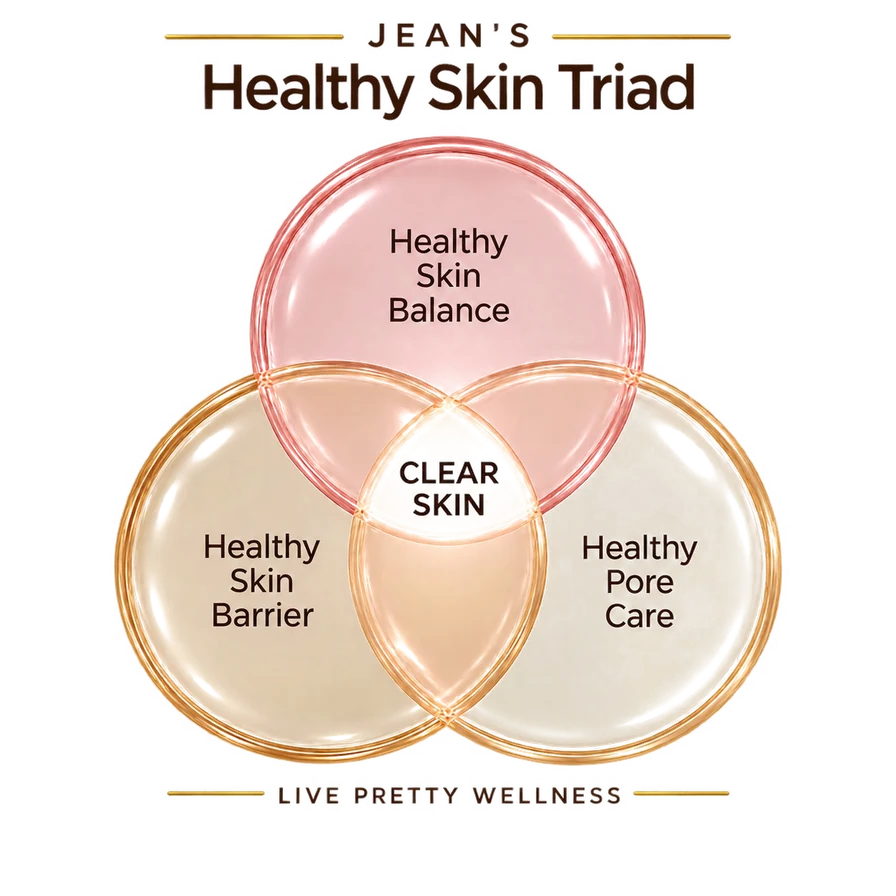
A breakout pattern makes more sense when you consider acne control, treatment tolerance, the rest of the routine, and what changed around the same time.
Jean's Purge-or-Breakout Check
Before you decide what the breakout means, ask:
- When?When did this start relative to tretinoin?
- Where?Is this my usual acne pattern or somewhere different?
- What does it feel like?Is significant irritation happening too?
- What else changed?Products, actives, makeup, hair care, treatments?
- Which direction?Is the overall pattern settling, staying the same, or getting worse?
- How severe?Are lesions becoming deeper, more painful, widespread, or more likely to scar?
Don't name the breakout before you read the pattern.
When “Is This Purging?” Becomes a Different Question
Consider professional evaluation when:
- acne is becoming substantially more severe
- painful or deep lesions are developing
- scarring is occurring or becoming more likely
- significant or persistent irritation is occurring
- swelling, blistering, or another concerning reaction develops
- the pattern is unusual for you
- the diagnosis is uncertain
- the treatment remains difficult to tolerate
- the acne remains inadequately controlled after an appropriate treatment trial
- you are considering changing a prescription because of what is happening
If you are pregnant, planning pregnancy, or have questions about tretinoin and pregnancy, discuss medication safety promptly with your healthcare provider.
Live Pretty Wellness provides education and individualized skincare strategy. It does not replace urgent or specialist medical care.
Jean's Bottom Line
Not every breakout after tretinoin is a purge.
Timing matters.
Location matters.
Irritation matters.
The rest of the routine matters.
And the direction of the pattern matters.
Instead of asking only:
"Should I push through?"
ask:
"What is the full pattern telling me?"
The goal is not to become better at guessing. It is to make the next skincare decision with more information than the last one.
Want Jean's Help Making Sense of Your Skin?
When several products, prescriptions, symptoms, and skin goals overlap, figuring out what changed can become the hardest part.
Get a Personalized Skincare StrategyWant to Meet Jean First?
Meet Jean Live — Free Q&ASources
- Reynolds RV, Yeung H, et al. Guidelines of care for the management of acne vulgaris. Journal of the American Academy of Dermatology. 2024;90(5):1006.e1–1006.e30. View on PubMed (opens in a new tab)
- American Academy of Dermatology. Acne: Diagnosis and Treatment. View resource (aad.org, opens in a new tab)
- National Institute for Health and Care Excellence (NICE). Acne vulgaris: management. NICE Guideline NG198. Current guideline, updated April 2026. View guideline (nice.org.uk, opens in a new tab)
- Aneri V, Catarino A, Eguren C, et al. Iberia Consensus on Strategies to Prevent and Manage Irritation by Topical Retinoids in Facial and Trunk Acne. View on PubMed (opens in a new tab)
Jean's own perspectives and frameworks above are her clinical reasoning, not claims attributed to these sources.

Jean
Nurse Practitioner Strategist
Founder, Live Pretty Wellness
Jean combines clinical reasoning with practical skincare strategy to help people make sense of acne-prone skin, prescriptions, skincare, skin response, and goals as parts of one picture.
About JeanYou May Be Wondering Next…
- Why Am I Still Breaking Out on Tretinoin?
- Why Does My Acne Keep Coming Back?
- Can I Use Azelaic Acid With Tretinoin?
- Can I use salicylic acid with tretinoin?
- Why is my skin barrier irritated while using tretinoin?
- Does peeling mean tretinoin is working?
- Can moisturizer make me break out while using tretinoin?
More answers are coming.
Back to Make It Make Sense