
Make It Make Sense
Why Am I Still Breaking Out on Tretinoin?
Answered by Jean, Nurse Practitioner Strategist | Live Pretty Wellness
The Clear Answer
You can still break out while using tretinoin for several reasons. It may be too early to judge the treatment, your use may not be consistent enough, irritation may be making the routine harder to tolerate, or tretinoin may be only one part of what your acne needs.[1]
The useful question is not simply:
"Why isn't tretinoin working?"
It is:
"What is happening around the tretinoin?"
Look at how long you have used it, how consistently you can tolerate it, what else is in your routine, whether your acne pattern has changed, and whether the treatment strategy addresses the type and severity of acne you have now.
Before You Blame the Tretinoin, Read the Pattern
This is a decision-support framework, not a diagnostic tool. Work through it in order.
1 How long have you actually used it?
Ask:
- When did you start?
- Have you used it consistently?
- Have there been long interruptions?
- Has irritation repeatedly forced you to stop?
Acne treatment is not usually judged after a handful of applications.
NICE guidance generally uses a 12-week review point for first-line acne treatment because improvement takes time and treatment needs an adequate trial.[2] That is a review point, not a promise about when any individual will be clear.
"Time matters — but time only tells us something useful if the treatment has actually been usable."
2 Can your skin tolerate the plan?
Look for:
- burning
- stinging
- persistent redness
- peeling
- tightness
- tenderness
- worsening sensitivity
- difficulty using moisturizer or sunscreen comfortably
Topical retinoids can cause irritation, particularly earlier in treatment.[3]
Irritation does not automatically mean an allergy or that tretinoin can never be used. But a treatment that repeatedly overwhelms the skin can become difficult to use consistently.
"Tolerability is part of treatment strategy."
3 What else are you using?
Consider the whole routine:
- cleanser
- tretinoin
- benzoyl peroxide
- salicylic acid
- azelaic acid
- exfoliating acids
- vitamin C
- moisturizer
- sunscreen
- pigmentation products
- scrubs
- masks
- makeup
- hair products
- professional treatments
Do not automatically assume one product is "clogging your pores."
Instead ask whether the total routine is tolerable, coherent, and appropriate for the skin's current needs.
"Your skin experiences the routine as a whole — not as separate product reviews."
4 What does the acne look like now?
Ask:
- Is it the same location?
- Same lesion type?
- Same severity?
- Same frequency?
- Same timing?
- Are there deeper or more painful lesions?
- Is scarring becoming more likely?
- Has the pattern changed?
Persistent acne does not automatically prove tretinoin has failed.
But a changing or inadequately controlled pattern deserves reassessment rather than endless experimentation. If your acne cleared and then returned, that is a slightly different question — Why Does My Acne Keep Coming Back? walks through reading a recurrence.
5 Is tretinoin the whole plan — or one part of it?
Tretinoin is a topical retinoid and is strongly recommended in acne guidelines.[1]
But acne treatment may use multiple mechanisms depending on the individual situation. The American Academy of Dermatology recommends topical retinoids and also supports combining topical therapies with different mechanisms of action when appropriate.[1]
This does not mean every person needs more medication.
This framework is general education and decision support. It is not a diagnostic tool, and it is not a reason to change a prescription on your own.
Tretinoin being useful and tretinoin being sufficient are two different questions.
How Long Does Tretinoin Take to Work for Acne?
Acne improvement takes time. A treatment should generally be given an adequate trial before deciding whether it is effective, assuming it can be used safely and consistently.
NICE recommends reviewing first-line acne treatment at approximately 12 weeks.[2]
That does not mean:
- everyone clears in 12 weeks
- worsening should automatically be ignored for 12 weeks
- severe irritation should simply be endured
- every breakout before 12 weeks is “purging”
The timeline has to be interpreted alongside tolerability, consistency, acne severity, and the rest of the treatment plan.
Am I Purging — or Am I Just Breaking Out?
People often use the word "purging" to describe breakouts that appear after starting a treatment that affects follicular cell turnover, including topical retinoids.
But not every breakout after starting tretinoin should automatically be labeled a purge, and timing alone is not enough to tell the difference.
Consider:
- when tretinoin was started
- where lesions are appearing
- whether this resembles your usual acne
- whether significant irritation is occurring
- what other products were introduced
- whether the acne is becoming more severe
- whether the pattern persists rather than improving
There is no single universal timeline that settles this, and "purging" is not a diagnosis you can confirm from a calendar.
Can Tretinoin Irritation Make Everything Harder to Read?
Yes.
Irritation can make it harder to tell what is acne, what is treatment-related irritation, and what the skin can realistically tolerate.
Topical retinoids commonly cause irritation such as dryness, peeling, redness, or discomfort, particularly during treatment initiation.[3]
The goal is not to prove you can tolerate the most aggressive routine. The goal is to create a treatment strategy that can actually be used appropriately — which is a conversation to have with the clinician who prescribed it.
Should I Add More Acne Products?
Not automatically.
When breakouts continue, adding another acid, scrub, spot treatment, or trending product can feel logical. But before adding something, ask:
- What problem am I trying to solve?
- What is tretinoin already doing?
- What else am I already using?
- Is irritation present?
- Does the additional treatment address a different acne mechanism?
- Can the overall routine remain tolerable?
More products do not automatically create a more complete strategy.
How Jean Thinks About Tretinoin in the Bigger Picture
Tretinoin is one part of a skin strategy.
Jean's Healthy Skin Triad considers Healthy Skin Balance, Healthy Skin Barrier, and Healthy Pore Care, with Clear Skin at their intersection.
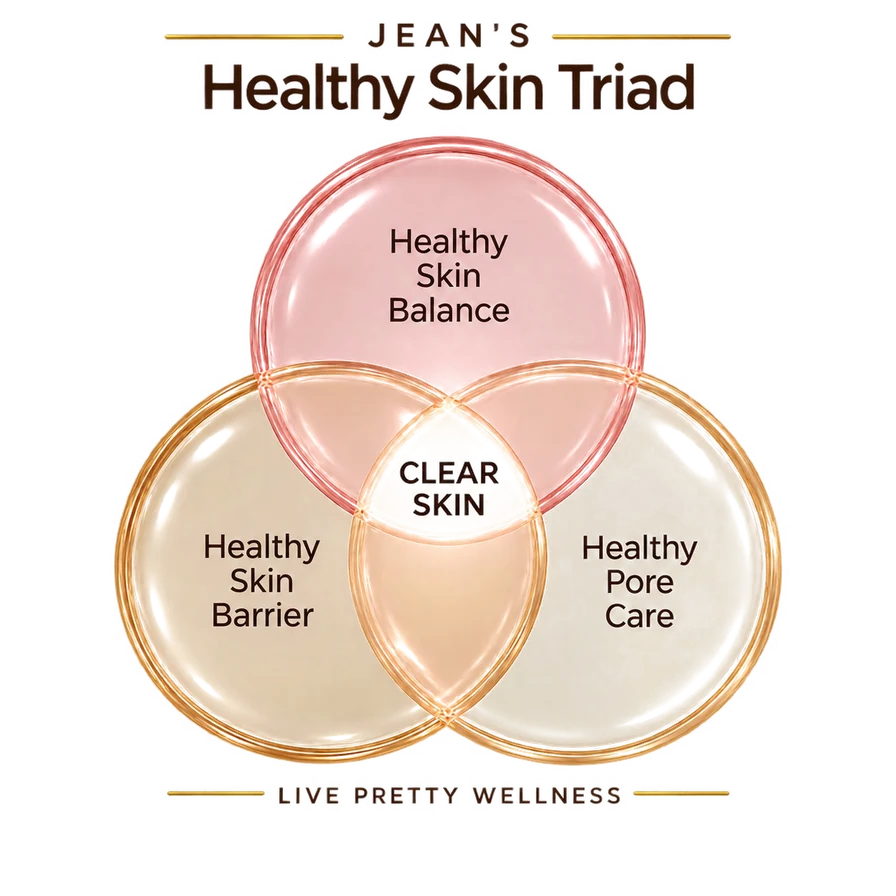
For someone using tretinoin, that means asking more than whether the prescription is "strong enough." It means considering acne control, tolerability, the rest of the routine, pigmentation goals, skin response, and whether the plan still makes sense as a whole.
What Should I Look At Before Deciding Tretinoin “Isn't Working”?
- How long have I actually used it?
- How consistently have I been able to use it?
- Is irritation interfering with the plan?
- What else is in my routine?
- Is this the same acne pattern?
- Has the severity or distribution changed?
- Is tretinoin expected to do the entire job?
- What am I trying to accomplish besides fewer breakouts?
That last question may include dark spots, uneven tone, sensitivity, texture, glow, aging concerns, or preventing acne marks from becoming the next problem.
The goal is not to grade tretinoin. The goal is to understand the skin strategy.
When Breaking Out on Tretinoin Deserves a Closer Look
Individualized evaluation may be useful when:
- acne remains inadequately controlled after an appropriate treatment trial
- acne becomes more severe
- painful or deep lesions develop
- scarring occurs or risk of scarring increases
- irritation makes the prescribed treatment difficult to tolerate
- the acne pattern changes meaningfully
- the diagnosis is uncertain
- multiple prescriptions, actives, and skincare products make the routine difficult to interpret
If pregnancy, pregnancy planning, or any medication-safety question is relevant, discuss it promptly with the clinician who prescribed your treatment.
Live Pretty Wellness provides education and individualized skincare strategy. It does not replace urgent or specialist medical care.
Jean's Bottom Line
Still breaking out on tretinoin does not automatically mean tretinoin failed.
Look at the timeline.
Look at consistency.
Look at tolerability.
Look at the acne pattern.
Look at the rest of the routine.
Look at whether tretinoin is being asked to do the entire job.
Then decide what actually needs to change.
The goal is not to keep adding products until something works. The goal is to understand why the current strategy is not giving you the control you expected — and make the next decision more intelligently than the last one.
Want Jean's Help Making Sense of Your Skin?
You may already have the tretinoin, the products, and the history. The harder question is what makes sense for your skin now.
Get a Personalized Skincare StrategyWant to Meet Jean First?
Meet Jean Live — Free Q&ASources
- American Academy of Dermatology. Guidelines of care for the management of acne vulgaris. View guideline (aad.org, opens in a new tab) Published version: Reynolds RV, Yeung H, et al. Guidelines of care for the management of acne vulgaris. Journal of the American Academy of Dermatology. 2024;90(5):1006.e1–1006.e30. View on PubMed (opens in a new tab)
- National Institute for Health and Care Excellence (NICE). Acne vulgaris: management. NICE Guideline NG198. View guideline (nice.org.uk, opens in a new tab)
- Aneri V, Catarino A, Eguren C, et al. Iberia Consensus on Strategies to Prevent and Manage Irritation by Topical Retinoids in Facial and Trunk Acne. View on PubMed (opens in a new tab)
Jean's own perspectives and frameworks above are her clinical reasoning, not claims attributed to these sources.

Jean
Nurse Practitioner Strategist
Founder, Live Pretty Wellness
Jean combines clinical reasoning with practical skincare strategy to help people make sense of acne-prone skin, prescriptions, skincare, skin response, and goals as parts of one picture.
About JeanYou May Be Wondering Next…
- Why does my acne keep coming back?
- How do I know if tretinoin is purging my skin or breaking me out?
- Can I use azelaic acid with tretinoin?
- Can I use salicylic acid with tretinoin?
- Why is my skin barrier damaged while using tretinoin?
- Do I need benzoyl peroxide if I use tretinoin?
More answers are coming.
Back to Make It Make Sense