
Make It Make Sense
Why Do I Keep Breaking Out in the Same Spot?
Answered by Jean, Nurse Practitioner Strategist | Live Pretty Wellness
The Clear Answer
Acne can keep showing up in the same area because some areas of your skin are simply more acne-prone than others.
Pores can repeatedly become clogged and inflamed, and factors such as oil production, hormones, friction, products, hair contact, and your overall acne pattern may make certain areas more likely to break out.[1]
But seeing another pimple in the same place does not automatically prove that:
- it is the exact same pore
- the old pimple “never really went away”
- one specific food caused it
- your liver or another organ is responsible
- a face map has identified the cause
- the breakout is definitely hormonal
The location is a clue. It is not a diagnosis.
The more useful question is whether you are seeing one recurring lesion, repeated acne within the same acne-prone zone, or something that only looks like acne.[4]
Those are not always the same problem.
Why Can Acne Keep Coming Back in the Same Area?
Because acne does not develop randomly across every inch of skin.
Acne develops when pores become clogged and inflammation develops.
Some areas may be more acne-prone because of factors such as:
- oil production
- hormonal influence
- repeated friction or occlusion
- hair or skincare products contacting that area
- touching or picking
- the underlying distribution of the person’s acne
The fact that acne repeatedly appears in one zone can therefore be useful information. But location alone usually cannot tell you the exact cause.
Patterns inform the question. They do not automatically answer it.
Is It Really the Exact Same Pore?
Not necessarily.
When a new blemish appears very close to where the previous one healed, it can look and feel like the exact same pimple returning. But without examining the skin, you cannot reliably conclude from appearance alone that the exact same follicle has repeatedly “refilled.”
It may be:
- another lesion in the same acne-prone area
- a persistent or incompletely resolved lesion
- a deeper inflammatory lesion
- a nearby clogged pore becoming inflamed
- something that resembles acne but requires a different diagnosis
That is why “it keeps refilling” is a description of what you are seeing — not an explanation of what is happening.[2]
Does Where I Break Out Tell Me What Is Causing My Acne?
Sometimes location provides useful context. It usually does not identify the cause by itself.
Where acne appears is part of a clinical assessment. A clinician may consider:
- forehead vs cheeks vs chin and jawline
- whether the acne is inflammatory or comedonal
- whether lesions are deep and painful
- whether breakouts follow a menstrual pattern
- whether hair products contact the area
- whether friction or occlusion occurs there
- whether the distribution has changed
- whether other symptoms are present
But location should be interpreted with the rest of the story.
What About Acne Face Mapping?
Be careful with acne maps that claim a pimple in one facial zone reveals a specific internal-organ problem.
Internet face maps may assign forehead acne to one organ, cheek acne to another, or chin acne to a specific internal imbalance. That is not how acne is clinically diagnosed.[1]
Location can matter. But a breakout location by itself does not diagnose liver problems, digestive problems, “toxins,” a specific food intolerance, a hormone disorder, or another organ problem.
A face map can give you a story. It cannot give you a diagnosis.
Why Does the Same Chin or Jawline Area Keep Breaking Out?
Chin and jawline acne can occur in adult acne and may sometimes have a hormonal component — but location alone does not prove that hormones are the cause.[3]
Consider the larger pattern:
- Does it flare predictably around the menstrual cycle?
- Are lesions deep or tender?
- Is acne occurring elsewhere too?
- Has the pattern changed?
- Are hair, makeup, skincare, masks, helmets, phones, hands, or other sources of friction or contact involved?
- Is there an established history of adult acne?
A jawline location is one detail inside a much larger clinical picture — not a conclusion on its own.
Could Something Touching That Area Be Contributing?
Possibly.
Repeated contact can sometimes matter. Examples worth considering include:
- hair and hair products
- makeup
- skincare
- helmets
- chin straps
- masks
- tight clothing or equipment where relevant
- phones
- habitual touching
- picking or squeezing
This does not mean a phone, a pillowcase, or a “dirty” object is automatically the cause of your acne. Acne is not a sign that you are unclean.
Look for repeatable patterns, not blame.
Could Spot-Treating Be Part of Why This Feels Endless?
Sometimes focusing only on the visible pimple misses the larger acne-prone area.
The American Academy of Dermatology advises that topical acne medication is generally applied in a thin layer over the acne-prone area rather than only to individual visible spots, when that is appropriate for the medication.[1]
Why? Because acne treatment often aims not only to treat what you can see today, but also to help prevent future lesions.
This does not mean:
- every acne medication should be applied everywhere
- every prescription has identical directions
- you should change your prescription instructions
Always follow the directions for your specific medication and treatment plan.
Acne management is often about preventing the next breakout — not only chasing today’s pimple.
Before You Call It “The Same Pimple,” Read These 5 Clues
You are not looking for a verdict. You are looking for a pattern.
1 Exact Spot or Same Zone?
Ask:
- Is the bump truly appearing in exactly the same location?
- Or do breakouts repeatedly appear within the same small area?
Those may look identical in the mirror but represent different patterns.
2 How Long Does It Really Last?
Ask:
- Does the lesion completely disappear between episodes?
- Does a bump remain underneath the skin?
- Does it repeatedly swell and calm down?
A lesion that never fully resolves deserves a different question than separate pimples appearing in the same region.
3 What Kind of Blemish Is It?
Is it:
- a whitehead?
- a blackhead?
- a small inflamed pimple?
- a deep painful bump?
- a cluster of similar bumps?
- something that drains or crusts?
Different lesion types can require different treatment approaches.[2] This is information to bring to an evaluation — not a self-diagnosis exercise.
4 What Happens Around That Area?
Think about:
- hair
- products
- makeup
- touching
- friction
- occlusion
- picking
- menstrual timing
- other recurring exposures
The goal is not to find something to blame. The goal is to identify patterns worth investigating.
5 Is the Rest of Your Acne Controlled?
Ask:
- Is this genuinely one isolated recurring spot?
- Or is acne still active elsewhere too?
If acne is continuing across multiple areas, repeatedly treating one visible lesion may distract from the larger acne pattern. That larger pattern is the subject of Why Does My Acne Keep Coming Back?
Why Does a Deep, Painful Pimple Keep Coming Back?
Deep, painful acne deserves more caution than a small occasional surface blemish.
Acne nodules and cyst-like lesions develop deeper in the skin and carry a greater risk of scarring.[5]
If a deep, painful lesion:
- persists
- repeatedly becomes inflamed
- does not resolve
- repeatedly drains
- leaves scarring
- or is part of a pattern of multiple deep lesions
professional evaluation is appropriate. Squeezing, lancing, draining, or injecting a lesion at home is not part of that plan.
What If the “Pimple” Never Completely Goes Away?
A bump that persists or repeatedly returns without fully resolving deserves a closer look.
Not everything that looks like acne is acne. Other skin conditions can sometimes resemble acne, and clinicians sometimes need to distinguish acne from other acne-like conditions.[4]
A persistent lesion should not be repeatedly self-treated forever based only on appearance.
A recurring acne pattern is one question. A lesion that never truly goes away is another.
Does Picking Make the Same Spot Come Back?
Picking can worsen inflammation and increase the risk of discoloration and scarring.[5]
It may also make it harder to understand what the lesion would have done naturally, because the skin is repeatedly being traumatized.
Picking is an extremely common response to a bump that will not go away. Noticing the habit is more useful than judging yourself for it.
Why Does This Matter More If I Get Dark Spots?
For skin that develops post-inflammatory hyperpigmentation, every new inflammatory breakout can leave another mark after the acne itself improves.[6]
This can create a frustrating cycle:
- breakout
- inflammation
- dark mark
- another breakout in the area
- more pigment to manage
That is one reason preventing new acne matters just as much as treating what is already visible.
Post-inflammatory hyperpigmentation is a pigment change. It is not the same as true acne scarring, which involves a change in skin texture.
Where Recurring Breakouts Fit Into Jean's Bigger Picture
Jean's Healthy Skin Triad considers Healthy Skin Balance, Healthy Skin Barrier, and Healthy Pore Care, with Clear Skin at their intersection.
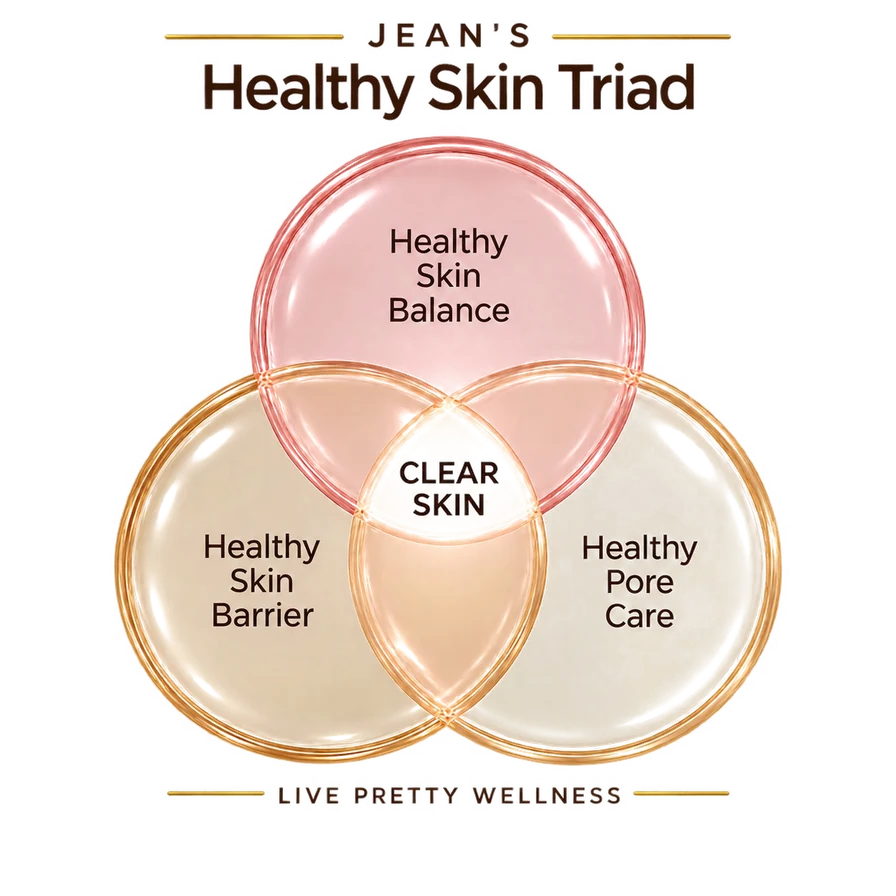
A recurring breakout may tempt you to attack one spot harder. But repeated irritation is not automatically better acne care.
The bigger strategy is to support:
- effective pore care
- a tolerable routine
- appropriate acne treatment
- enough skin support to stay consistent
The goal is not to win a battle with one pimple. The goal is to create a strategy that helps reduce the next breakout too.
Jean’s “Same Spot” Check
Before deciding that the exact same pimple keeps returning, ask:
- SpotIs it truly the exact spot — or the same acne-prone zone?
- TimeDoes it completely disappear between breakouts?
- TypeIs it a small surface blemish or a deeper painful lesion?
- PatternDoes it follow a menstrual, product, friction, hair, or other repeatable pattern?
- Rest of the SkinIs acne controlled elsewhere?
- HealingIs the area healing normally, or is one lesion persisting, draining, crusting, or scarring?
Don’t just chase the spot. Read the pattern.
When a Recurring “Pimple” Deserves a Closer Look
Consider professional evaluation when:
- the same lesion does not fully resolve
- a bump is deep or significantly painful
- it repeatedly drains or crusts
- scarring is developing
- acne is worsening despite treatment
- multiple deep lesions are developing
- the appearance does not seem typical for your usual acne
- you cannot tell whether it is acne
- recurrent breakouts are leaving substantial hyperpigmentation
- the overall acne pattern remains uncontrolled
Live Pretty Wellness provides education and individualized skincare strategy. It does not replace urgent or specialist medical care.
Jean's Bottom Line
If acne keeps coming back in the same spot, don’t let the location become the diagnosis.
Ask:
- Is it truly the exact same lesion, or the same acne-prone zone?
- Does it completely resolve?
- What kind of blemish is it?
- What repeatedly happens around that area?
- Is acne controlled everywhere else?
The location may help you see the pattern. The pattern helps you ask a better question.
Want Jean's Help Making Sense of Your Skin?
When the same area keeps breaking out, it is easy to keep treating the spot without understanding the larger acne pattern.
Get a Personalized Skincare StrategyWant to Meet Jean First?
Meet Jean Live — Free Q&ASources
- American Academy of Dermatology. Acne: Diagnosis and treatment. View resource (aad.org, opens in a new tab)
- American Academy of Dermatology. Acne: Signs and symptoms. View resource (aad.org, opens in a new tab)
- American Academy of Dermatology. Adult acne treatment: Dermatologists recommend. View resource (aad.org, opens in a new tab)
- American Academy of Dermatology. Is that stubborn acne really acne? View resource (aad.org, opens in a new tab)
- American Academy of Dermatology. Tips to treat a deep, painful pimple. View resource (aad.org, opens in a new tab)
- Reynolds RV, Yeung H, Cheng CE, et al. Guidelines of care for the management of acne vulgaris. Journal of the American Academy of Dermatology. 2024;90(5):1006.e1–1006.e30. View on PubMed (opens in a new tab)
Jean's own perspectives and frameworks above are her clinical reasoning, not claims attributed to these sources.

Jean
Nurse Practitioner Strategist
Founder, Live Pretty Wellness
Jean combines clinical reasoning with practical skincare strategy to help people make sense of acne-prone skin, prescriptions, skincare, skin response, and goals as parts of one picture.
About JeanYou May Be Wondering Next…
- Why Does My Acne Keep Coming Back?
- Why Does Every Moisturizer Seem to Break Me Out?
- Why Am I Still Breaking Out on Tretinoin?
- How Do I Know If Tretinoin Is Purging My Skin or Breaking Me Out?
- How Do I Fade Dark Spots Without Breaking Out Again?
- Is my skin barrier damaged — or am I just breaking out?
- Is this fungal acne — or regular acne?
- Why do I keep getting closed comedones?
- Could my hair products be causing my acne?
More answers are coming.
Back to Make It Make Sense